



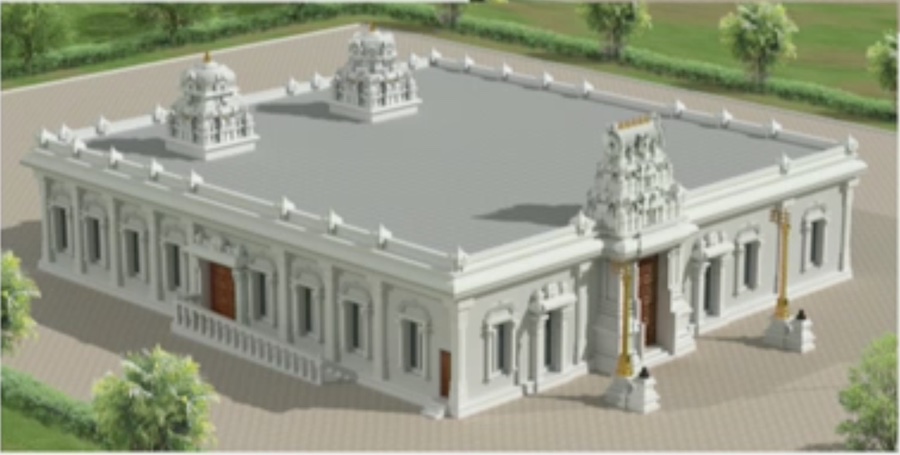
Flower Mound Town Council unanimously approved two exceptions requested by the Flower Mound Hindu Temple at its meeting on Monday.
One of the exceptions was a request to build a flat roof instead of a sloped roof, which is required for buildings in the Town that are smaller than 15,000 square feet. The request was submitted by the applicant, and approved by Council, because temples in the Hindu religion are to be built with a flat roof, according to ancient scriptures.
The second exception was a request to waive the enforcement of a 25-foot landscape buffer between a non-residential property and residential properties. It was requested, and approved, because denial would have prevented access to the property.
“All of the concerns the residents have brought up are valid,” said Deputy Mayor Pro-Tem Adam Schiestel. “The driveways being close together and having your house back up to a driveway is not great, but it’s part of the problem with the property, it has nothing to do with the application.”
The lot that the temple will be built on is tricky because of how it was mapped. Its only access point is a narrow strip that goes behind residences on Walnut Grove Place. This type of lot is called a “flag lot,” which Schiestel said is no longer allowed by the Town.
Residents raised concerns, similar to when they did at the Planning and Zoning meeting in June, about traffic, noise, parking and general compatibility.
However, similar to what was iterated by the P&Z Commission, religious institutions are allowed under the current agricultural zoning of the property, so the Town could only vote on the exceptions requested by the applicant.
“It’s a challenging property, no matter how we engineer it,” said Schiestel. “That’s a problem for property owners and residents. We aren’t here to approve the Hindu Temple or not, it has already been approved. We are only here to decide on the exceptions and we are not able to deny access to a property.”
If council had denied the exception and essentially denied the only access to the property, it could have led to significant legal problems for the Town.
According to Town staff, under federal statute, “any governmental regulation that places a substantial burden on the practice of religion, the Town is required to show a compelling basis for the reason why, and compatibility and trees are more about aesthetics, not public safety, so it’s questionable whether they reach the level of a compelling governmental interest.”
If the Town denied the exception to the 25-foot buffer, which would prevent reasonable access to the property, it could violate the constitution and open the door for the Town to get sued.
Other than a few residents that voiced concern about the traffic, noise and compatibility, there was overwhelming support for the project.
“Never have I gotten so many emails about an agenda item,” said Mayor Cheryl Moore. “I got 150 emails in support of the Hindu temple and none in opposition.”
With approval, the temple will begin construction and has plans to finish its first phase in the fall of 2026, when use will begin.
To make it a better experience for their neighbors, the Hindu Temple will plant more trees around its property, which will be evergreen to maintain an aesthetically-pleasing atmosphere year-round.
In regards to traffic, Temple leadership said temple use is often outside of high-traffic times: the late morning and in the evening. They also mentioned reaching out to schools to make plans for any traffic that may conflict with school events.
Councilman Chris Drew encouraged the applicant to try and work with Lewisville ISD to try and figure out a joint access easement.
Temple leadership also said they would, but, according to engineer Jason Kilpatrick, the district has been difficult to work with in the past.
With new Superintendent Lori Rapp, they hope to have a better chance at collaboration.
During the public hearing at P&Z, a resident that lives on Walnut Grove Place offered to buy the property for $800,000 so they could move the project down the road. He brought up the same idea at Town Council, but the Temple’s Board said this plan was not feasible.