



By Barbara Brown, Master Gardener
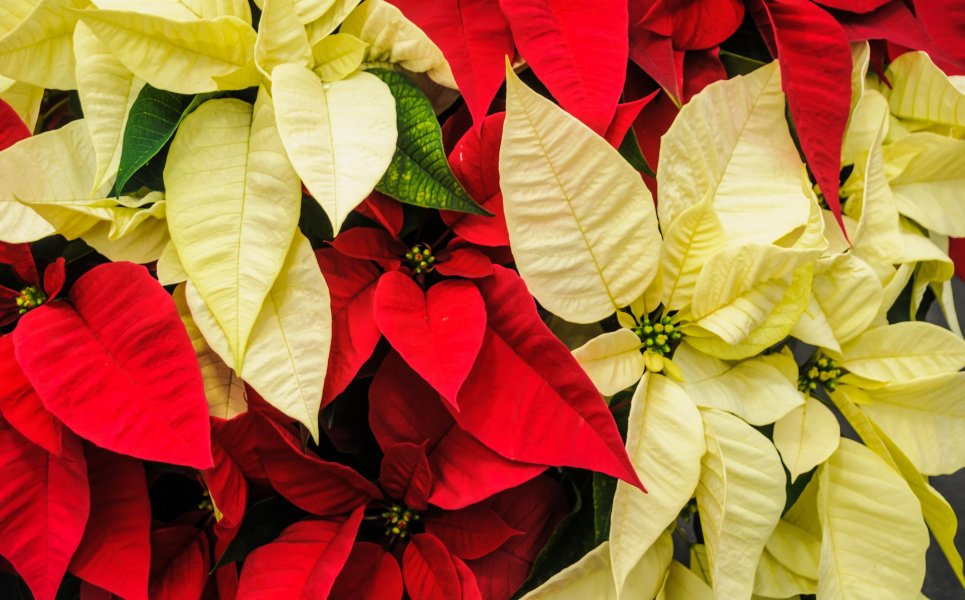
The poinsettia (Euphorbia pulcherrima) can be a perfect holiday-time accent with its bright red flowers, which are not flowers at all. They’re bracts, or specialized leaves.
The actual poinsettia flowers are the small yellow balls in the center of the bract. If red is not your desired color, you can find speckled varieties with cream, pink or even solid white.
These lovely plants will accent an entrance or a hearth if you provide them with some indirect light to keep them healthy and bright. The light may come from a south-facing window or a skylight. Additional lighting can be supplied with either incandescent or fluorescent lights. Be sure to select a location that does NOT get hot air blown from heating vents or cold air from frequently opened outside doors.
Your poinsettia plant will require supplemental water to remain healthy and vibrant. Because many commercial growers use “soilless” mixes of sphagnum peat, vermiculite, perlite or similar ingredients, it is sometimes difficult to decide when the plant needs water. If there is no heavy component (sand or soil) in the mix and a plastic pot is used, the pot can be lifted to determine its weight. If the plant is heavy, there is usually plenty of moisture in the pot. However, if it is lightweight, then the medium is dry, and a thorough watering should be given preferably with purified water. Never leave the plant standing in water. Make sure there are drainage holes in the decorative wrap covering the pot. Lift out of any tray so that the water can drain fully. We don’t want rotting roots.
The pot’s moisture needs can also be assessed by feeling the growing medium in the pot. Water when the top of the growing medium is starting to feel dry, but do not allow too much drying. You may also use a soil moisture meter available from local garden supply stores to check soil moisture.
If you want to keep your poinsettia alive after the holidays, you can do that successfully with a bit of care. Although it may never bloom again, a poinsettia can be a foliage plant for your patio or landscape. To transition your plant to living outdoors, here is what to do: in March, while it is still indoors, cut back the foliage to about 4 to 6 inches and add some regular potting mix to the container. After all the danger of a freeze, frost, or even temperatures below 50 degrees has passed, you can move the container outside into a lightly shaded area. Usually, mid-April works safely in North Texas. Add supplemental water when the plant is dry but avoid underwatering or overwatering. Apply a complete house plant fertilizer once a month throughout the summer. Then, bring the plants back indoors in the fall.
Note: Poinsettias are considered mildly toxic to pets. The sap may also cause dermatitis in susceptible individuals, according to experts from Purdue University. Poinsettia plants are not harmful to household pets unless the leaves and bracts are eaten in very large quantities. Some cats that chew on the leaves may salivate and can vomit if the leaves are swallowed.
Happy Gardening!