



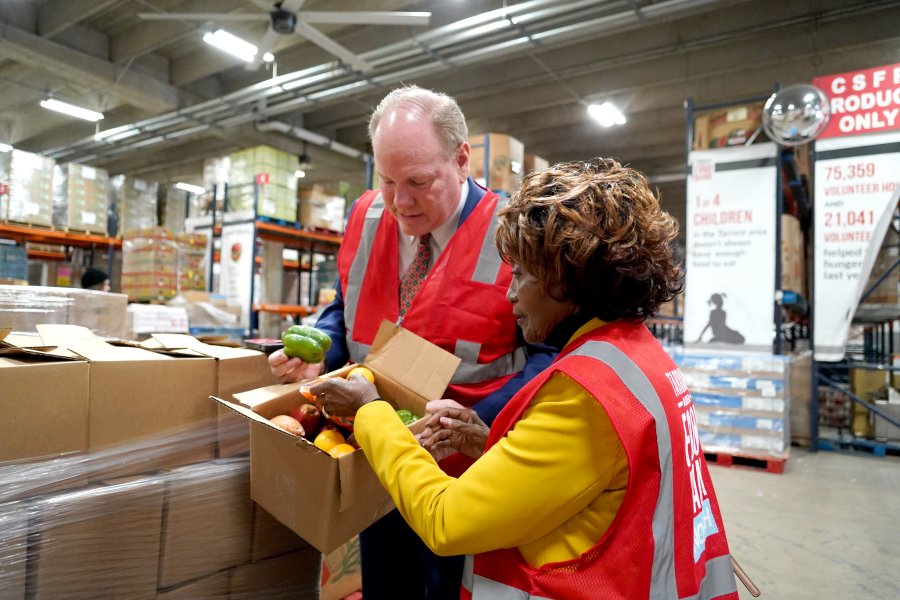
On Nov. 25, hundreds of employees and volunteers from the Tarrant Area Food Bank stood ready at C.H. Collins Athletic Complex in Denton as a long line of hungry families eagerly awaited free Thanksgiving dinners and all the fixings. The doors opened at 9 a.m., and by the time the end-hunger event ended two hours later, they’d served roughly 1,000 families.
Scenes like this have become the norm across North Texas, including right here in southern Denton County. In a typical year, the organization already serves more than 580,000 people and distributes 1.2 million meals each week across 13 counties. Over the past nine months—since assuming full responsibility for serving Denton County’s food-insecurity needs—it has provided three million more meals locally than the two food banks that previously served this area did during the same period the year before.
Most people see those staggering numbers and assume we are winning the fight against hunger.
The truth is more nuanced. Yes, the region’s hunger-relief network has grown stronger, more coordinated, and more innovative. That said, the demand is significant, so much so that many leaders feel as though they’re trying to fill a bucket with a hole in the bottom.
“Texas recently passed California as the hungriest state in the nation,” Tarrant Area Food Bank President and CEO Julie Butner said. “North Texas is particularly high because we have a lot of people here, and of those people, a large percentage live paycheck to paycheck. They are working, but they don’t have enough to cover rent, utilities, gasoline for their cars, and, of course, food. What happens next is that more and more families turn to the charitable food system to bridge the gap in their household budgets.
“As a business person, it’s hard to wrap your head around it and come up with a way to fix it. As a human being, it’s hard to see so many people struggle and remain hungry. No one wants that to happen to anyone. This is the USA. Everyone should have food.”
Butner brings a unique perspective to the challenge. A dietitian with a master’s in food systems management, she spent seven years working in healthcare before a recruiter reached out with an opportunity to lead the Tarrant Area Food Bank into the future as its President and CEO. Initially, she thought it was a crazy move—but something about it resonated deeply.
“What attracted me was understanding what it feels like to be in crisis,” she said. “It can happen to anyone. Feeling that pain and knowing I could help address it in my community meant something. It felt almost like a godsend—the right time, the right place.”
She’s not alone in those sentiments. Across North Texas, countless smaller nonprofits, church pantries, school programs, and community coalitions are working tirelessly together to meet that challenge. And they all work collaboratively with Butner and her team at the Tarrant Area Food Bank. Founded in 1982, the Tarrant Area Food Bank has grown into the region’s primary food hub, supported by three campuses and an 80,000 square-foot distribution center. As a regional clearinghouse for donated food, it provides a nutritious mix of fresh, frozen, and shelf-stable products.
Thanks to that backbone, the food bank and its frontline partners have more resources, support, and reach than ever before.
Even so, the scale of the need can feel overwhelming. Hunger isn’t easing—it’s evolving, expanding, and showing up in places it never used to. Three million people live in the 13 counties served by the food bank, and 580,000 are considered food-insecure. That includes children, who make up roughly a quarter of those in need. Butner points to several factors driving the crisis: the rising cost of food, housing, gas, and child care, as well as wages that often don’t keep pace with basic expenses.
But day by day, meal by meal, the region’s network continues to strengthen its response—and change lives in the process. The three million meals provided to Denton County over the past nine months generated roughly $23 million in economic impact for the area.
Local partners include Lovepacs, Denton County Friends of the Family, Argyle Food Bank, Lantana Community Church, Denton Freedom House, Our Daily Bread, Heart of the City, the Salvation Army and Christian Community Action.
The organization also partners with local governmental entities — including libraries, community centers and public health and human services facilities — to deliver services throughout the community.
Butner also said their recent event in Denton was another positive step in the right direction.
“I think what we saw in those lines of people was gratitude,” she said. “These are families who are embarrassed that they are in this position, but they are also incredibly grateful for the help we give them. It was almost joyous in a way, even though it was a heartbreaking situation. Giving and receiving can be a joyous experience. It means a great deal to those families. It also means a great deal to the volunteers that they can give back to the community in this way.”
As for next steps, Butner said it’s essential to address the root cause of food insecurity by paying better wages and creating more affordable housing and childcare options. Inflated food prices must also be addressed quickly to stem the tide.
“I hope that we experience real systematic changes that reduce our nation’s dependency on emergency food organizations,” Butner said. “I don’t think the problem will go away entirely—there are so many retired people living on fixed incomes, disabled veterans, etc. That said, we have to figure out a way to take more positive steps forward. There’s no reason people should be without food.”
To learn more about the Tarrant Area Food Bank, including ways to donate and volunteer, please visit www.tafb.org.